Newton's Laws of Motion
F = ma
Read the guideNewton's laws, energy conservation, waves and quantum mechanics — explained in plain English and brought to life with simulations, calculators and games you can actually play.
Six foundational ideas that unlock the rest of physics. Each one blends visual intuition with the maths that makes it precise.
F = ma
Read the guidev = fλ
Read the guideE = ½mv²
Read the guideR = v²sin2θ / g
Read the guidev = fλ
Read the guideΣp = const
Read the guideSix things that make learning physics here genuinely click.
From kinematics to quantum mechanics — every core topic, explained in a clear, connected sequence.
Ten browser games let you tweak variables and watch real physics respond in real time.
Worked examples and graded problems that turn passive reading into genuine understanding.
We lead with intuition, then bring in the maths — so the equations finally make sense.
Twenty physics calculators that solve for any variable and show every formula used.
No paywall, no fluff. High-quality physics education that stays free for everyone, forever.
Every major branch of introductory physics, each with in-depth articles, calculators and games.
Forces, motion, energy and momentum — the laws that govern everything you can see and touch.
Heat, entropy and engines — the rules behind energy flow and the arrow of time.
Sound, light, interference and lenses — how energy travels and how we see the world.
Charges, fields and circuits — the unified force powering modern technology.
Relativity, atoms and nuclei — where classical intuition breaks and reality gets strange.
Displacement, velocity and acceleration — the precise language of motion itself.
Launch projectiles, balance orbits, build circuits and steer lasers. Every game runs on real physics — and links to the article that explains it.
Play the gamesIntuition-first explainers and answers to the questions physics classes tend to skip.
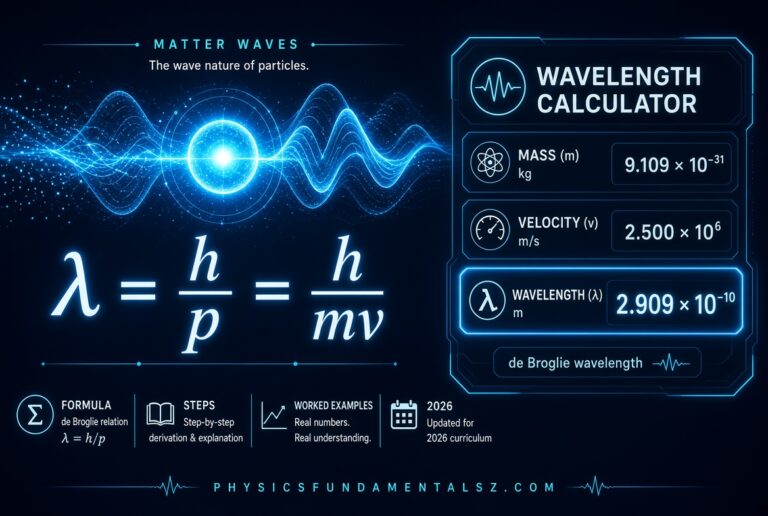 Modern Physics
Every moving object has a wavelength, even a thrown baseball. A de broglie wavelength calculator turns that strange quantum fact…
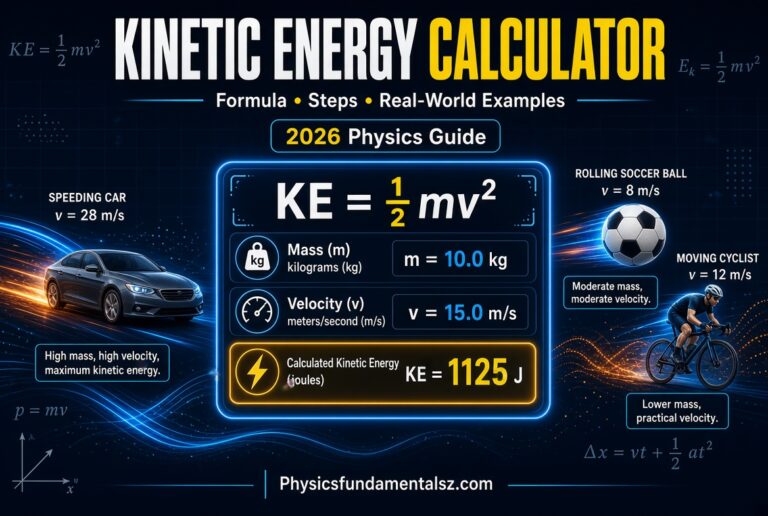 Classical Mechanics
A kinetic energy calculator physics tool lets you find the energy of any moving object in seconds. Instead of rearranging…
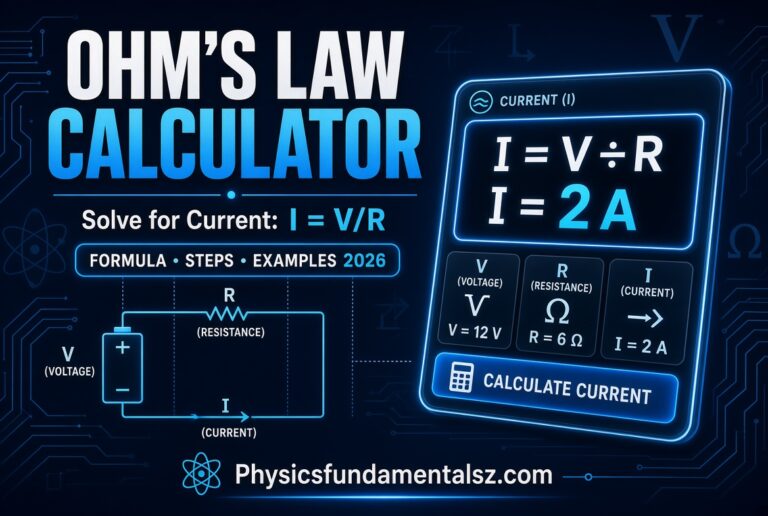 Electromagnetism
Flip a switch and current starts flowing before you even finish the motion. That current isn’t random. It follows one…
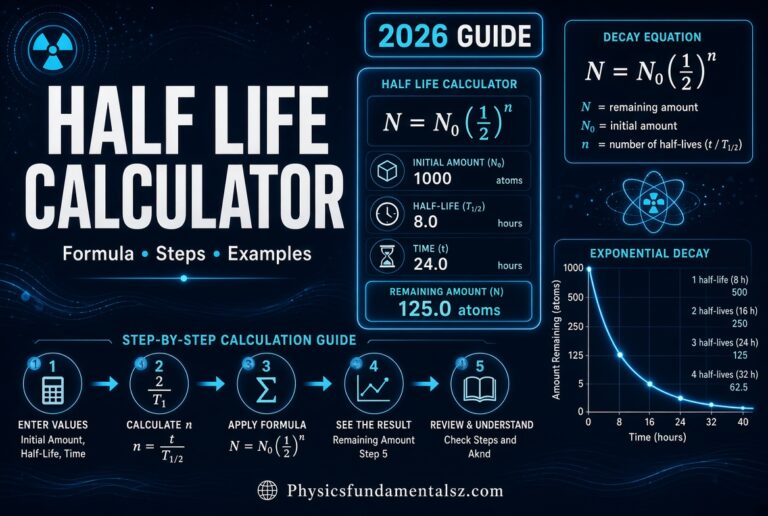 Modern Physics
Radioactive isotopes, medications, and even chemical reactions all shrink by the same predictable pattern. Half of what remains disappears every…
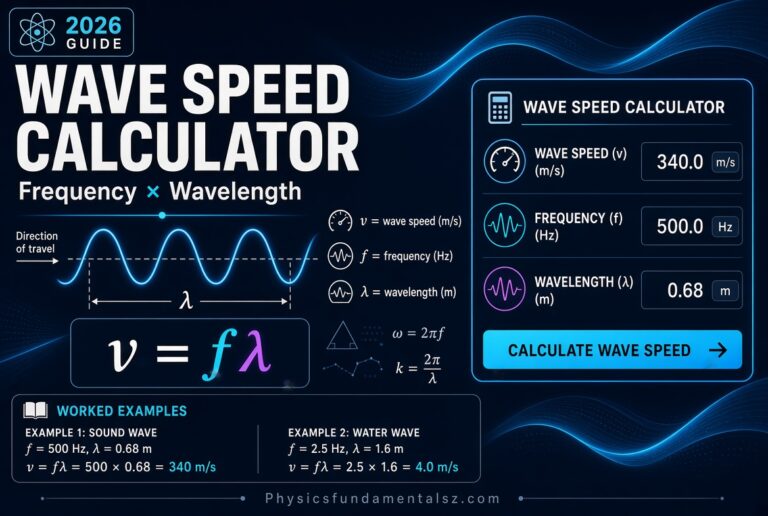 Waves & Optics
Every wave you have ever seen, from a guitar string to a beam of light, obeys one clean rule. Speed…
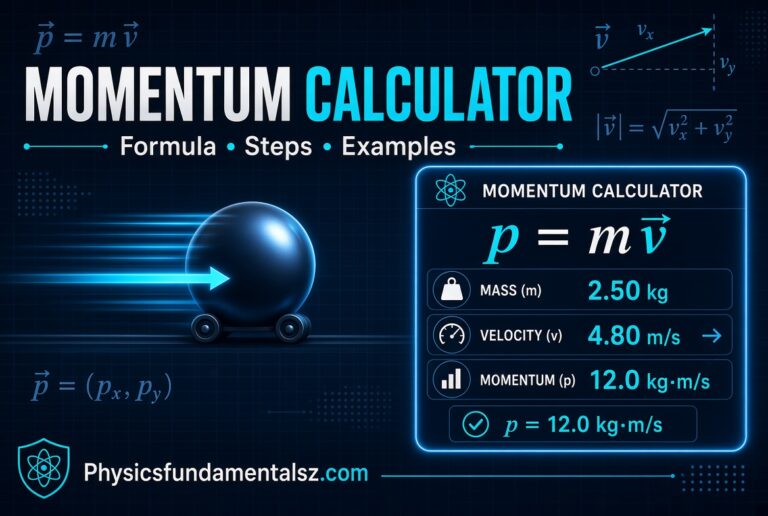 Kinematics
A momentum calculator physics tool solves one simple equation, p = mv, but knowing when and why to use it…
From projectile motion to Ohm's law to the ideal gas law — plug in what you know, solve for what you don't, and see every formula used along the way.
Open the calculatorsBe first to get new lessons, simulations and practice sets as they launch.
Physics fundamentals are the core principles — Newton's laws, conservation of energy and momentum, waves, thermodynamics and electromagnetism — that every other topic in physics is built on. Master these and the rest of physics becomes far easier to follow.
Yes. Every article, calculator and interactive game on Physics Fundamentals is free to use, with no account required. We believe high-quality physics education should be available to everyone.
Articles are written and reviewed by a team of physics educators and graduate-level specialists across mechanics, thermodynamics, electromagnetism and modern physics, so explanations are both accurate and genuinely clear.
We cover the full introductory physics syllabus: kinematics, dynamics, energy, momentum, rotational motion, gravitation, oscillations, waves, optics, thermodynamics, electromagnetism and an introduction to modern physics.
Textbooks tell; we let you play. Alongside clear writing you get interactive simulations and calculators that let you change variables and watch the physics respond — building intuition a static page never can.
Start with kinematics and Newton's laws, use the matching game or calculator to test each idea, then work outward into energy, waves and electromagnetism. Each article links to the tools and topics that come next.